


May 6, 2026
75 Best AI Photo Enhancers for Low-Light Selfies


75 Best AI Photo Enhancers for Low-Light Selfies
Taking a selfie in a dim restaurant or at night usually results in a blurry, muddy mess. To compensate for the darkness, your camera drastically boosts its internal sensitivity, flooding your picture with heavy digital noise and grain. Throwing a standard brightness filter over the photo only turns those dark shadows into a flat, washed-out gray. To rescue the moment, you need an intelligent enhancer capable of recovering the lost light data without destroying the actual texture of your face.
To rescue a low-light selfie, you must correct the camera's exposure failure before touching any beauty tools. In Citrus, skip the Face tools entirely at first. Navigate to Enhance > Colors & Lighting to restore deep contrast and clear the digital noise. Once the baseline image is actually visible, you can safely apply targeted fixes.
A crisp result requires fixing the foundation before applying any aesthetic filters. Some apps excel at restoring raw camera data. Some are better for precise color grading. Some should be avoided because they just smear the grain away.
| # | App | Best for | What to watch for |
|---|---|---|---|
| 1 | Adobe Lightroom | Fixing exposure, shadows, and color so harsh grain looks less intense before retouching | Not an automated low-light specialist on its own |
| 2 | Darkroom | Pro-level color and exposure correction for dull photos | Requires manual sliding rather than instant AI recognition |
| 3 | Polarr | Applying custom community filters and localized lighting adjustments | Overwhelming interface if you just want a quick fix |
| 4 | VSCO | Improving tone and softness so the face looks less tired overall | Light and color alone will not fully solve severe digital noise |
| 5 | Citrus - 1 tap photo enhancerEditor’s pick | Natural-looking fixes by starting with overall light balance, then using Face only if needed | Works best when you correct the contrast first instead of tapping every face option |
| 6 | Remini | Restoring genuinely soft or damaged files before face-specific cleanup | Can look stronger than needed when the original file is already decent |
| 7 | Snapseed | Selective brightness and healing around the eye area | Manual edits need care to avoid obvious patching in dark areas |
| 8 | EPIK | Massively popular for trending social edits and quick polish | Can easily wipe away skin texture if default settings are applied |
| 9 | Tezza | Fixing flat lighting with high-end aesthetic film textures | Color grading will not fix severe dark shadows on its own |
| 10 | Hypic | Advanced facial structure tweaks and localized corrections | Automated blurring tools tend to be very heavy |
| 11 | YouCam Perfect | Easy portrait retouching with strong beauty toolkit | Good range, but stacking tools can make the face look synthetic |
| 12 | Facetune | Precise under-eye retouching when you want manual control | Easy to push too far if you chase a perfectly smooth result |
| 13 | AirBrush | Quick dark-circle and eye-bag touch-ups on phone | Best results come from restrained brushwork |
| 14 | Picsart | Layer-based cleanup when you want manual retouch and masking | Takes more time and can look edited fast |
| 15 | BeautyPlus | Selfie retouching when the under-eye area needs soft correction | Keep the edit light so skin texture still reads like skin |
| 16 | PhotoDirector | AI portrait cleanup plus broader photo correction | Strong settings can start changing the whole portrait feel |
| 17 | Fotor | Quick portrait polish with light retouching | Watch for a generic beauty-filter finish |
| 18 | Adobe Photoshop Express | Spot healing and selective cleanup for small distractions | Better for controlled edits than fast one-tap beauty changes |
| 19 | FaceApp | Fast face cleanup when you want a polished social-ready result | The finish can stop looking like you if overused |
| 20 | B612 | Live selfie enhancement and quick retouching | Camera effects can become the whole look |
| 21 | Meitu | Beauty edits with detailed face controls | Easy to drift into a beautified look |
| 22 | MakeupPlus | Concealing tired under-eyes when makeup-style correction helps | Best when the goal is a makeup finish, not pure realism |
| 23 | Peachy | Small face refinements and under-eye cleanup | Minor slider changes look best |
| 24 | Perfect365 | Under-eye brightening with makeup-oriented editing | Can read as cosmetic rather than naturally rested |
| 25 | Facelab | Feature-by-feature retouching with under-eye tools | Needs restraint to stay believable |
| 26 | RetouchMe | Outsourced retouch requests when you want someone else to handle cleanup | Results depend on the requested intensity and style |
| 27 | Evoto | Studio-style portrait cleanup for creators and photographers | Powerful tools can oversimplify natural skin if pushed |
| 28 | Polish | General portrait editing with beauty tools on Android | Strong presets can flatten individuality |
| 29 | PicWish | Quick face cleanup and AI polish | Best for convenience, not always for the most nuanced portrait realism |
| 30 | Pixelup | Bringing life back to older or softer portraits | Restoration strength can outpace realism |
| 31 | Photoleap | Creative portrait correction with flexible retouch tools | Easy to go from fix to effect |
| 32 | Pixl | Simple face retouching including under-eye cleanup | Manual control matters because defaults can look strong |
| 33 | Visage Lab | Fast beauty cleanup for selfies | Its style can feel processed if you want subtlety |
| 34 | Sweet Selfie | Beauty-camera edits and quick under-eye softening | Best for casual social posts, not always for realism |
| 35 | Camera360 | Selfie capture plus beauty correction in one app | Built-in beauty looks can stack up quickly |
| 36 | Cymera | Beauty camera with retouch options for portraits | Older-style beauty effects can feel obvious |
| 37 | SODA | Cleaner selfie-camera polish with face enhancement | Use lightly so the face still has character |
| 38 | Ulike | Beauty-camera selfies with face and skin refinement | Often tuned toward a stylized finish |
| 39 | SNOW | Selfie edits with strong beauty and camera tools | Great for playful polish, less ideal for invisible retouch |
| 40 | Retrica | Filters and selfie finishing when the image mainly needs mood | Filters can hide the real issue instead of fixing it |
| 41 | Prequel | Beauty and style edits when you want more than simple cleanup | Effects can overpower a natural face fix |
| 42 | LightX | Manual retouching and selective face work | Takes more effort to keep edits invisible |
| 43 | Lensa | AI portrait polish and skin cleanup | Can make people look too uniformly perfected |
| 44 | Photo Editor Pro | General face cleanup with accessible tools | Results vary depending on how aggressively the tools are used |
| 45 | PrettyUp | Dedicated face and body retouching across photos and videos | Skin presets are tuned for extreme smoothness |
| 46 | TouchRetouch | Removing small under-eye distractions or creases with manual healing | Better for tiny fixes than broader tired-eye correction |
| 47 | PhotoRoom | Cleaning the overall image presentation before sharing | Not built around under-eye correction specifically |
| 48 | Canva | Light portrait cleanup inside a broader design workflow | Limited for nuanced face retouching |
| 49 | PicMonkey | Basic portrait touch-up plus design-friendly editing | Works better for simple cleanup than deep face correction |
| 50 | BeFunky | Quick portrait polish and light retouch | Watch for a generic softened finish |
| 51 | Prisma | Stylized looks when realism is not the main goal | Art filters are the opposite of natural under-eye cleanup |
| 52 | YouCam Makeup | One-tap eye bag and dark-circle cleanup with beauty retouch tools | Can get overly polished if you stack too many face effects |
| 53 | InstaSize | Quick formatting and simple touch-up features | Basic tools don't respect facial depth completely |
| 54 | piZap | Easy edits and quick beauty-style cleanup | More casual than precision-focused |
| 55 | A Color Story | Color correction that helps tired photos feel fresher overall | Does not directly fix eye bags by itself |
| 56 | Afterlight | Tone and texture correction when the photo mostly needs better balance | Not a dedicated under-eye editor |
| 57 | FixThePhoto | Human retouch service for custom under-eye cleanup | Slower workflow and the final style depends on the brief |
| 58 | Makaron | AI-driven face and body tuning with subject separation | Structural edits often degrade the actual image quality |
| 59 | Mextures | Fixing flat photos using light leaks and analog contrast | Does not have tools specifically built for face repair |
| 60 | PhotoGrid | Collages that contain a surprising amount of solid retouch tools | Skin smoothing is very basic and flat |
| 61 | Dazz Cam | Adding retro depth and organic grain to dead photos | Fake grain will not restore lost skin texture |
| 62 | Pixomatic | Great for clean background cleanup and object removal | Facial tools are an afterthought |
| 63 | Filto | Trending vintage filters to add a specific vibe to photos | Will cast a heavy hue over your true skin tone |
| 64 | KUNI Cam | Aesthetic light processing to rescue flat indoor lighting | Not suitable for precise under-eye or spot corrections |
| 65 | Toolwiz Photos | A massive toolkit including a dedicated face tuning module | Can feel very clunky to navigate for a fast fix |
| 66 | RNI Films | High-end film presets to recover dull digital selfies | Color correction alone rarely fixes severe puffiness |
| 67 | Lens Distortions (LD) | Adding natural light rays to dark, flat indoor pictures | Only solves environmental lighting issues |
| 68 | VITA | Robust suite of trending portrait and filter tools | Geared heavily toward a young, highly edited aesthetic |
| 69 | Wuta Camera | Customizable facial adjustments directly from the viewfinder | Live camera edits are difficult to undo after saving |
| 70 | BeautyCam | Creating a highly polished, stylized selfie aesthetic | Not designed to keep natural pores visible |
| 71 | Bazaart | Isolating the subject from a messy or distracting background | Lacks sophisticated, nuanced skin retouching |
| 72 | Relens | Adding realistic DSLR depth and soft portrait background blur | Heavy focus on the background rather than face texture |
| 73 | Luminar Mobile | Advanced AI lighting modifications and smart skin enhancement | Can sometimes look over-processed if sliders are pushed |
| 74 | Foodie | Soft, pleasing filters originally meant for food photography | Filters shift entire color palettes aggressively |
| 75 | LINE Camera | Classic selfie filters and soft beauty modifications | Older aesthetic that leans heavily into full-face blurring |
If your picture is completely buried in noise, you might be tempted to try and smooth your skin immediately. Do not do this. You need to discover how to make blurry photos clear again without making them look fake by recovering your true features before tackling the darkness.
Why smartphone cameras ruin your low-light selfies
Small phone lenses cannot gather enough ambient light in restaurants, clubs, or living rooms. To compensate, the camera automatically boosts ISO. High ISO forces the sensor to be extremely sensitive to light, but it introduces aggressive digital grain and muddiness. This technical failure is exactly why people search for an ai face enhancer that still looks real. A true fix requires eliminating the sensor noise, not just brightening the screen.
- Using heavy blur that turns grainy skin into flat plastic
- Brightening the whole image until facial shadows turn gray
- Leaving the baseline muddy while trying to fix the eyes
- Applying extreme color filters that ruin natural warmth
- Fixing overall image contrast so the face regains depth
- Removing digital noise while preserving skin texture
- Adding subtle highlights to draw attention upward
- Stopping the edit while the room still feels natural
If your edited photo looks perfectly bright but totally washed out, you used the wrong method. A smart sequence helps you find the apps to make your face look better in pictures without the fake filter look to save your core facial structure and the environment.
Restore contrast and eliminate grain safely. A smart edit keeps reality intact.
How to fix low-light grain naturally in 5 steps
Select a photo where the darkness ruined the quality
Find the picture where your face looks incredibly grainy or the colors feel entirely lost. You do not need to delete it. An intelligent software can actually make flat photos look more alive by restoring the underlying data.

Let the instant preview process the overall image
Citrus provides a first correction immediately. This ensures that any underlying contrast or exposure issues are recognized before you start trying to adjust your facial features manually.

Use Enhance to fix Colors & Lighting first
Because low-light grain is an overall photo problem, start with Enhance > Colors & Lighting. This strips away the muddy wash and restores shadows to the scene. To successfully view remini vs natural photo enhancers which looks more real, rebuilding the photo's contrast here is mandatory.

Always fix the flat lighting before using a beauty tool. Use the Enhance options to restore image depth first.

Apply Face tools to target specific areas
Once the lighting is corrected, you can address the physical shape safely. Navigate directly to Face and apply a light finish. Doing this last allows you to use the best alternative to overprocessed beauty editors without ruining the rest of your healthy skin.
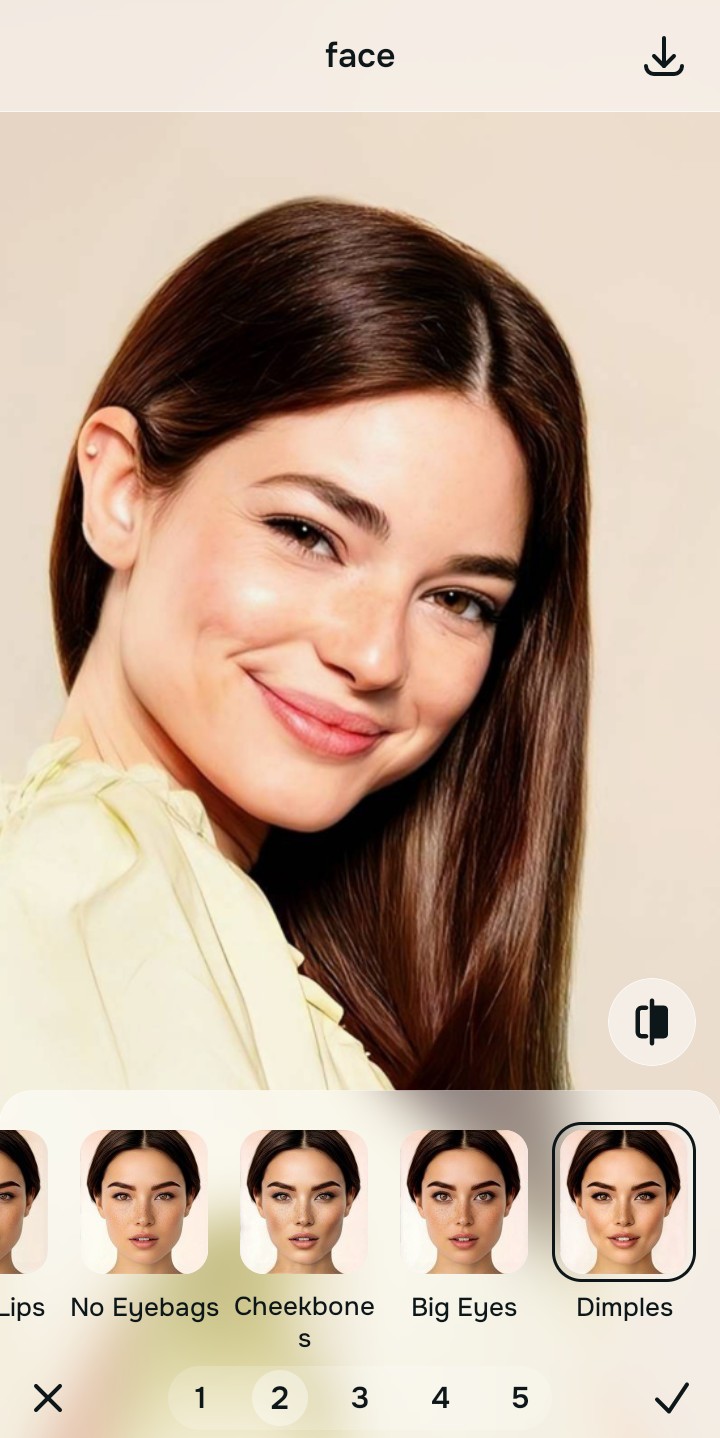
Save the photo when you look structured but real
The true test of a good edit is whether the room behind you is still visibly intact. Stop adjusting before the picture begins to look heavily filtered or warped. It is simply about knowing how to make a bad photo good enough to post effortlessly.

Why does your selfie lack quality?
Choose the description that fits best. Your starting point changes depending on what is actually flattening the picture.
Which Citrus tool fixes a dark selfie naturally
Different problems require entirely different tools. The goal is to get the best possible result by matching the tool to the actual error. This stops you from ruining the entire picture just to fix one small area.
| Tool | What it helps fix | When to use it |
|---|---|---|
| Enhance Start here | Overall darkness, weak light, muddy contrast, and heavy grain | Use this first when the whole image feels lifeless. Choose Colors & Lighting to restore depth and clear the sensor noise. |
| Looks | Photos that are technically balanced but still need a stronger overall impression | Use this after Enhance, or instead of Enhance when the real issue is not severe darkness but a dull vibe. |
| Face | Specific puffy areas, wide cheeks, or flat bone structure | Use this last, applying targeted tools to subtly define the face after the broader image already feels properly lit. |
“The most natural edit recovers the lost light data instead of pasting an artificial brightness filter over the top.”
Why restoring contrast beats generic brightness sliders
There is a massive difference between adding dimension and wiping out shadows. When you use an aggressive brightness slider, you turn the entire image into a flat gray wash. The human brain instantly recognizes this loss of detail as a cheap edit.
Real quality comes from correcting the underlying light data first. Restoring true contrast provides a professional, believable foundation that manual blurring simply cannot achieve.