


October 1, 2026
How to Fix Neon Night Portraits Without Turning Skin Purple

How to Fix Neon Night Portraits Without Turning Skin Purple
Neon lights create incredible atmosphere, but their intense, narrow-band frequencies overwhelm smartphone sensors, causing severe color clipping. This sensor washout leads to flat, detail-less faces bathed in unnatural magenta or blue hues. When you look worse in photos taken at night, it is because the camera cannot interpret the high-contrast spectral data accurately. Conventional editing tools attempt to mask this by layering synthetic pixel generation over the skin, resulting in an artificial, plastic appearance that destroys your true features. Citrus takes a radically different approach. By relying on mathematical recovery and optical physics, it analyzes the underlying structural density of the image. Instead of hallucinating false skin tones, Citrus recalibrates the luminance and chrominance channels, mapping the true baseline data to restore your genuine, mirror-accurate appearance without corrupting the atmospheric neon glow.
Utilize optical decompression to restore true skin tones. Citrus applies mathematical recovery to isolate the neon color channels from your skin's baseline spectral reflectance. By recalibrating the exposure gradients mathematically rather than pasting synthetic colors, it revives your natural complexion while preserving the authentic neon ambience of the environment.
Understanding the "Neon Sensor Clipping" Trap
Smartphone sensors prioritize average scene luminance, which fails spectacularly under high-intensity, monochromatic neon lighting. The extreme saturation of neon signs forces the camera's auto-white balance algorithm to panic, projecting intense purple or magenta across all mid-tones. This creates a destructive spectral shift that flattens facial depth and obliterates natural skin pigments.
- Overwriting natural skin textures with synthetic pixel generation
- Distorting facial geometry with aggressive warping algorithms
- Applying uniform, opaque color masks that ruin ambient lighting
- Hallucinating false features that create a plastic appearance
- Recalibrates chrominance channels through mathematical recovery
- Preserves structural density for mirror-accurate depth
- Isolates neon frequencies without disrupting skin reflectance
- Utilizes optical physics to map true baseline data
Overcoming the neon lighting trap requires abandoning destructive filters. By shifting from synthetic alterations to pure mathematical recovery, you can salvage the original sensor data and bring back your true aesthetic.
Restore your mirror-accurate look. Experience pure optical decompression for your night portraits.
A 5-Step Test: Fixing Neon Washout Naturally
Upload the raw, unedited photo
Always begin with the untouched, original photograph straight from your camera roll. Compressed or previously filtered images lose crucial spectral data required for accurate optical decompression.

Let the instant preview map baseline data
Once imported, Citrus initiates an instant environmental scan. Instead of hallucinating arbitrary skin tones, the engine maps the real-time structural density of the image, analyzing how the neon light physically interacts with your facial geometry.

Tap Enhance and choose Colors & Lighting
Before addressing specific color shifts, you must stabilize the image's dynamic range. Selecting the Colors & Lighting module recalibrates the baseline exposure. This is crucial because adjusting localized skin tones before you fix yellow indoor lighting or intense neon shifts will result in compounding color errors.

Baseline contrast stabilization is mandatory. Correcting the foundational luminance curve allows the mathematical recovery algorithms to distinguish between the neon source light and the ambient reflection on your skin.
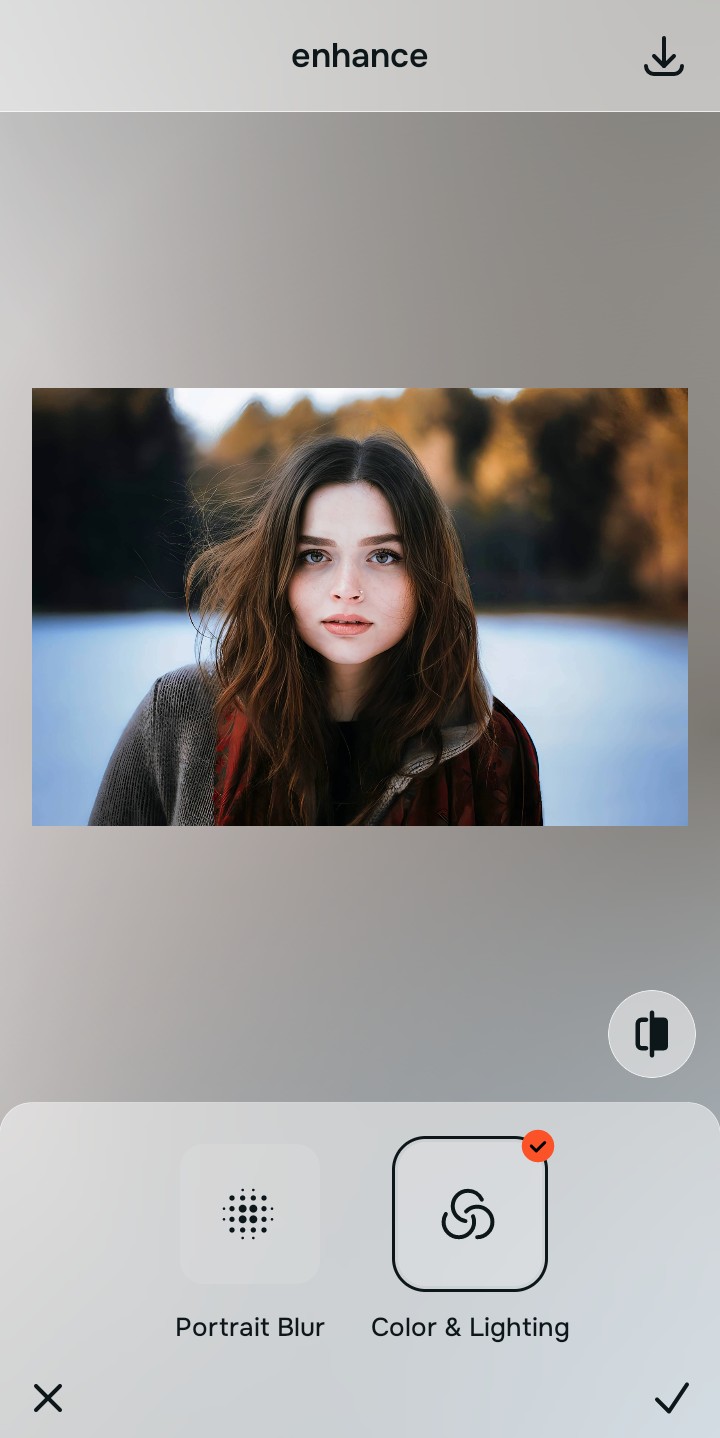
Tap Face and select Glass Skin
Navigate to the Looks menu and select Soft Glow. This specific tool employs optical decompression to gently diffuse the harsh spectral clipping caused by the neon source. By mathematically recovering the mid-tone gradients, it effectively lifts the invasive purple cast off your skin while maintaining the vibrant background aesthetic. This ensures you can improve makeup photos without changing your natural appearance.

Export your authentic, mirror-accurate master file
Review the recalibrated portrait. The neon atmosphere is maintained, but your skin is restored to its true, mirror-accurate state. Export the master file directly to your device, completely unwatermarked and structurally intact. This is the optimal way to make flat photos look alive without resorting to synthetic enhancements.
Why did your photo fail?
Identify your primary optical hurdle to select the exact automated pathway in Citrus.
Aligning Your Edits with the Citrus Taxonomy
Instead of gambling with generative apps that turn you into a plastic doll, Citrus categorizes enhancement into three distinct, mathematically safe pathways based on preserving real artistry:
| Tool Pathway | Primary Flaw Remediated | Automated Fix Strategy |
|---|---|---|
| Enhance Overall Photo | Global color clipping and severe magenta saturation. | Applies global optical decompression to separate distinct light frequencies. |
| Looks | Harsh specular reflections and unnatural skin color casts. | Utilizes localized mathematical recovery to diffuse neon glare smoothly. |
| Face | Loss of facial geometry due to high-contrast neon flattening. | Restores mirror-accurate depth by mapping true structural density. |
“True enhancement is about correcting the sensor's optical failure, not overwriting your natural identity with synthetic pixels.”
Why Physical Recovery Beats Fake Filters
Generative editing applications approach complex lighting scenarios by completely disregarding the original sensor data. When confronted with intense neon portraits, these tools rely on synthetic pixel generation, aggressively painting over the natural image. This results in a plastic, uncanny valley effect where your unique facial characteristics are replaced by generalized, hallucinated textures that fail to match the environmental lighting context.
Citrus rejects this destructive methodology in favor of pure optical physics. By treating the neon washout as a mathematical distortion of light, Citrus applies sophisticated optical decompression algorithms to the raw pixel data. It actively maps the structural density of the scene, safely stripping away the invasive color cast while mathematically recovering the lost mid-tones. This scientific approach guarantees a mirror-accurate result that authenticates your true appearance.